15
Dignity, autonomy & community
Caliban and Those Who Led by Listening
The elder whispered in his ear: “Your secret name is Calibán…”
The boy had packed his brightest shirt. He wanted to be noticed wherever they were going. But by the time they reached the mountains of Chiapas, mist had swallowed the road, his shoes were brown with mud, and the shirt was hidden beneath a borrowed jacket.
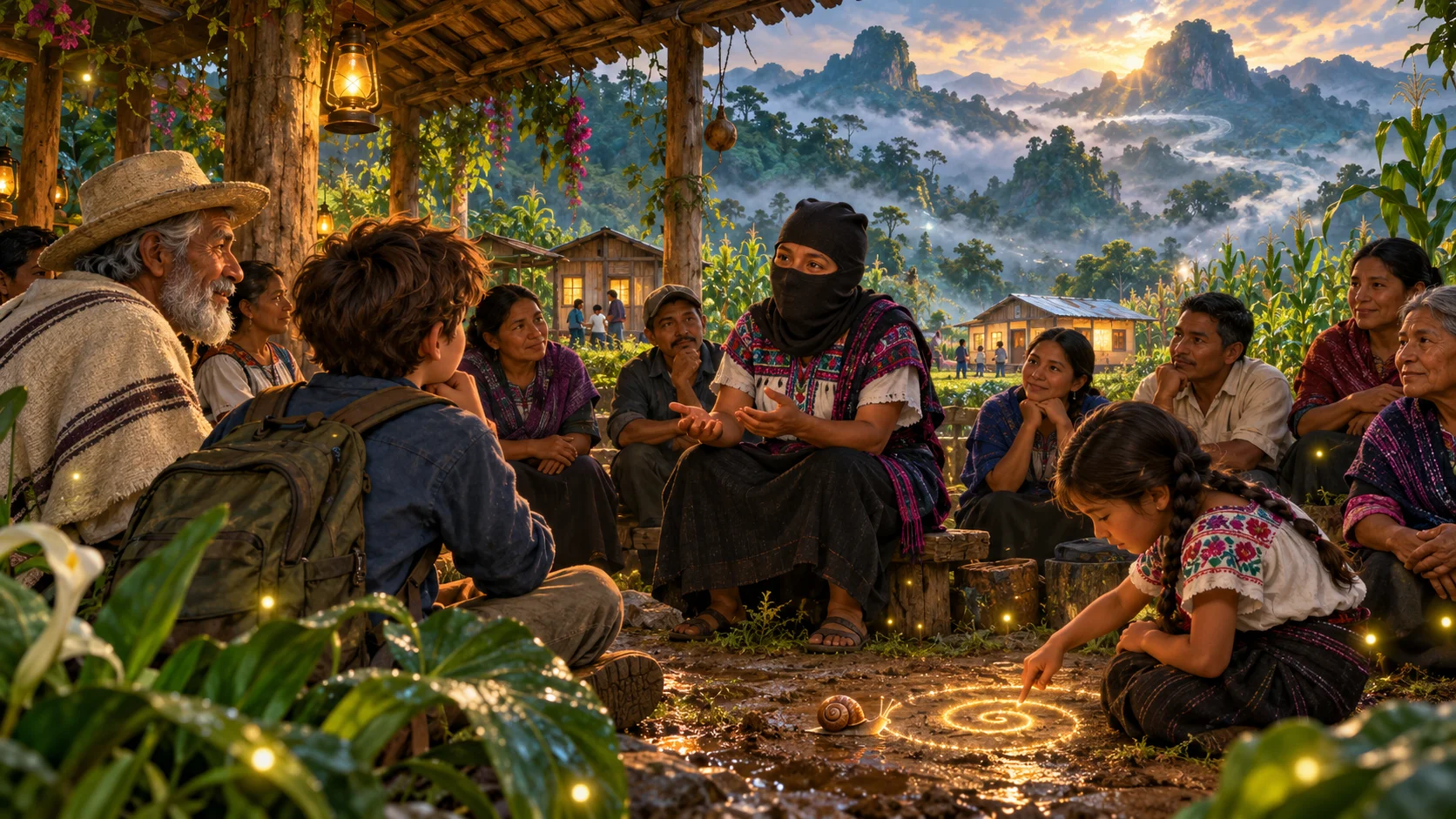
Under a roof dripping with rain, a girl was drawing a spiral in the earth. Behind her stood a school, a small clinic, and a meeting house with benches of different heights. The boy looked for a palace. Then for a grand doorway. Then for someone giving orders.
“Who is in charge here?” he asked. The girl lifted her stick. “What do you need?” “I want to know who commands.” “Then you will have to listen.”
Inside the meeting house, people were arguing about water. A pipe had broken above the village. A woman wanted it repaired before anyone did anything else. A man said the school roof could not survive another storm. Someone near the doorway asked who would care for the children while the others worked.
The boy waited for the person at the front to strike the table. Instead, she wrote down what the others said. When she missed a concern, a woman corrected her. She crossed out a line and began again.
“But she is supposed to be the leader,” the boy whispered. “She has a responsibility,” the girl answered. “That does not make our voices hers to replace.”
The rain thickened. The boy shifted on the bench. “A machine could decide this in a second.” The girl turned toward him. “Would it know whose house has no water? Would it ask who always carries the buckets?” He opened his mouth, then looked at the people he had not yet heard.
At last they agreed on a first step: inspect the pipe before dividing the work. Not everyone was satisfied. One man left shaking his head. The woman at the front promised to bring the findings back to the meeting. Nobody applauded. People fetched tools.
Outside, a woman wearing a dark face covering lifted a bundle of boards. The boy stared, then looked away. “May I ask something?” “You may ask.” “Why cover your face if you want people to see you?”
She rested the boards against a wall. “For a long time, people looked straight at our uncovered faces and acted as though we were not there.” A drop of water caught on the cloth beside her cheek. “This helped some people finally notice us. But being noticed is only the beginning. We still have to be heard.”
The boy thought of his bright shirt. He had imagined visibility as something he could put on. Now he was standing before someone whose face he could not fully see, and he was listening more carefully than he had all morning.
On the meeting house wall, he noticed another spiral. “Why a snail?” “A caracol,” the girl said. She traced its curve with one finger, going inward and then outward. “You can come in to listen. You can go out carrying what you learned.” Then she picked up two buckets. “Can you carry one?”
They followed the elder toward the spring. At a fork, the boy stopped. One trail was wide; the other disappeared beneath leaves. “Which way?” he asked. The elder studied the mud. “I do not know.”
“But you brought me here.” “Yes.” “And now?” The elder tilted his head toward footsteps beyond the trees. “Now we can ask.”
A woman returning from the fields told them the wide trail ended at a fallen bridge. They took the narrow one. Soon the spring appeared, pouring over stone. The girl filled her bucket. “Sometimes you find the way by asking as you walk,” she said.
Near the damaged pipe, the boy suggested joining two loose ends. A man examined them and shook his head. The boy felt heat rise into his face. “You asked for help.” “And I am glad you came,” the man said. “Come closer. Look at the crack.”
He looked. The break ran farther than he had noticed. His quick repair would have hidden it. Together they measured the damaged section. The boy held one end of the string while the girl marked the length.
Back in the village, a lesson was taking place beneath the driest part of the school roof. In the clinic, a woman counted supplies and frowned at an almost empty shelf. Beyond the houses, corn grew beside beans and squash. There was work everywhere, and nowhere did it seem finished.
“Are these the Zapatistas?” the boy asked the elder. “This is one of their communities,” he replied. “Listen to the people who live here. One visit cannot tell you everything.”
Before they left, the boy found the girl beside her spiral. “Did you win?” “Win what?” “The government. The country. Everything.” She looked toward the meeting house, where the argument about tomorrow had already begun.
“We have things to care for,” she said. “And things to change.” She smoothed a place in the earth and handed him the stick. “What would you build where you live?”
The boy tried to draw a school, but the roof came out crooked. He started to erase it. Then he left it there and added people beneath it. One was smaller than the others. This time he made room for that person near the middle.
On the way home, he took off the borrowed jacket. His bright shirt was still bright. At the next fork he almost walked ahead, certain that he knew. Then he stopped and turned toward the others. “Does anyone know what is beyond this path?”
The elder smiled, but said nothing. From somewhere behind them came an answer the boy had not expected. He waited until it was finished.